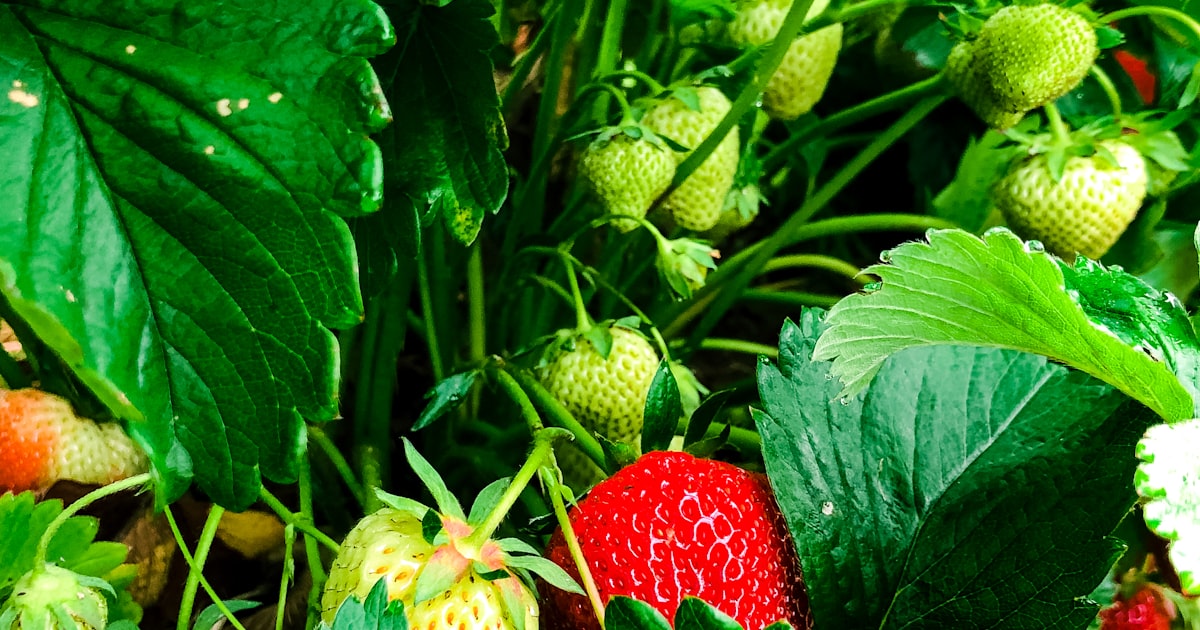
There is nothing, and we mean absolutely nothing, that compares to the taste of a sun-warmed strawberry picked straight from the garden. Supermarket strawberries are a pale imitation. They’ve been bred for shelf life and travel durability, not flavour. Homegrown strawberries are a completely different experience: smaller, sweeter, more aromatic, and ridiculously satisfying to grow.
The catch? Strawberries do require a bit of patience and planning. They’re not a “sow and forget” crop. But the reward is so worth the effort, especially if you’ve got kids who need convincing that gardening is fun.
Quick Facts
| Detail | Info |
|---|---|
| Family | Rose (Rosaceae) |
| Sun | Full sun |
| Water | Regular |
| Difficulty | Moderate |
| Time to Harvest | 12 to 16 weeks |
Runners vs Potted Plants
You can start a strawberry patch two ways.
Runners are the baby plants that strawberries send out on long stems from the mother plant. They’re essentially free plants. If you know someone with an established strawberry patch, ask for runners in late summer or autumn. Snip them from the parent plant once they’ve rooted, and plant them in their new home.
Potted plants from the nursery are the easier option for beginners. You’ll find them widely available in autumn and early winter. Choose plants that look healthy with bright green leaves and no signs of disease.
Either way, the planting technique is the same: set the crown (the point where the leaves emerge from the roots) at soil level. Too deep and it will rot. Too high and the roots will dry out. Getting this right makes a big difference.
When to Plant (It Depends Where You Live)
Timing matters with strawberries, and it varies by climate zone.
- Cool/temperate zones (Melbourne, Adelaide, Hobart, Canberra): Plant in late autumn to early winter (April to June). The cold period helps initiate flowering.
- Warm temperate (Sydney, Perth): Plant in autumn (March to May).
- Subtropical (Brisbane, Gold Coast): Plant in late autumn to winter (May to July). Choose varieties suited to milder winters.
- Tropical (Far North QLD): Strawberries struggle in true tropical conditions. If you want to try, grow in containers in a partly shaded spot during the coolest months.
In most of Australia, autumn planting is the way to go. This gives plants time to establish roots before they start fruiting in spring and summer.
Short-Day vs Day-Neutral Varieties
There are two main types of strawberries to choose from, and understanding the difference helps you plan your harvest.
Short-day varieties produce one big flush of fruit in late spring to early summer. They give you a concentrated harvest, which is great if you want to make jam, freeze berries, or have a strawberry feast. Popular varieties include Chandler and Red Gauntlet. (You may see these called “June-bearing” in Northern Hemisphere guides, but in Australia they fruit around November and December.)
Day-neutral (everbearing) varieties produce fruit over a longer period, typically from spring through to autumn, with peaks in spring and autumn. You won’t get as many berries at once, but you’ll have a steady trickle over many months. Albion and Temptation are popular day-neutral choices.
For most home gardeners, everbearing types are the better choice. A handful of fresh strawberries every few days is more useful than a mountain of berries all at once (unless you’re into jam-making, in which case, go for it).
SWEET SUCCESS STARTS HERE
Get strawberry growing guides for your exact climate
VeggieCrush tells you the best varieties and planting times for strawberries in your area. Personalised, simple, and free.
Download the free appStraw Mulch: It’s in the Name
Ever wonder why they’re called strawberries? One popular theory is that growers traditionally used straw mulch around the plants, and the name stuck.
Whether that’s historically accurate or not, straw mulch is genuinely one of the best things you can do for your strawberry patch. It keeps the fruit clean and off the soil (reducing rot and slug damage), conserves moisture, suppresses weeds, and keeps roots cool.
Apply a 5 to 8cm layer of clean straw around and between plants, tucking it right up under the fruit. Replace it as it breaks down. Sugar cane mulch works well too.
Bird Netting: Non-Negotiable
If you grow strawberries without bird netting, you are growing strawberries for birds. Full stop.
Birds adore strawberries. They’ll watch from a nearby branch, wait until the berry is perfectly ripe, and swoop in to take it the morning you planned to pick it. Every. Single. Time.
Cover your strawberry patch with bird netting secured to a frame or hoops. Make sure the netting is taut and doesn’t drape directly onto the plants, as birds can poke through loose netting. Check the netting regularly to make sure no birds or lizards have become tangled.
Runner Management
Strawberry plants send out runners throughout the growing season. These are long stems with baby plants at the tip that root wherever they touch soil.
If you want more plants, let selected runners root and then snip them from the parent once established. This is the cheapest way to expand your patch.
If you want maximum fruit production, pinch off runners as they appear. Every runner a plant produces takes energy away from fruit production. Regularly removing runners redirects that energy back into making berries.
Most gardeners do a bit of both: let a few runners root for next season’s plants and remove the rest.
Companion Planting with Borage
Borage and strawberries are one of the classic companion planting pairs. Borage attracts pollinators with its beautiful blue flowers, which means more thorough pollination of strawberry flowers and, therefore, bigger, better-shaped fruit.
Some gardeners also believe borage improves the flavour of nearby strawberries, though this is more folk wisdom than science. Either way, borage is a lovely, easy-to-grow plant that self-seeds freely and looks gorgeous next to a strawberry patch.
Other good strawberry companions include chives (which may help deter aphids), lettuce (a good use of space between strawberry rows), and beans (which fix nitrogen in the soil).
PERFECT PARTNERS
Find the best companions for your strawberries
VeggieCrush shows you which plants grow best together, helping your strawberries thrive alongside the right neighbours.
Download the free appContainer Growing
Strawberries are one of the best fruits for container growing. Their shallow root system and compact size make them perfect for pots, hanging baskets, and even vertical planters.
Use a container at least 20cm deep with good drainage holes. Fill with quality potting mix and add a slow-release fertiliser. Water regularly because containers dry out fast, especially in summer.
Strawberry-specific pots with multiple planting pockets are popular and make good use of vertical space on balconies and patios. A single pocket pot with 6 to 10 plants can produce a respectable harvest.
Perfect for Kids
If you want to get children interested in gardening, strawberries are your secret weapon. Kids love them because:
- They can plant them, water them, and watch them grow.
- The fruit is at kid height (no ladders needed).
- Strawberries are sweet and delicious straight off the plant.
- There’s something thrilling about finding ripe berries hidden under leaves.
- The whole process, from planting to picking, is tangible and rewarding.
Give kids their own strawberry pot or patch and let them take ownership. It’s one of the most reliable ways to spark a lifelong love of growing food.
Ongoing Care
Feed strawberry plants every 2 to 3 weeks during the growing season with a liquid fertiliser that’s higher in potassium (potash) to encourage fruiting. Seaweed-based fertilisers are also excellent.
Remove any dead or yellowing leaves promptly to improve air circulation and reduce disease risk. After the main harvest, trim back old foliage to stimulate fresh growth.
Strawberry plants are productive for about 3 years. After that, they decline. Plan to replace your patch every 3 years using runners from your existing plants. This keeps your strawberry production going indefinitely at minimal cost.
The Bottom Line
Growing strawberries takes a bit more planning than throwing some seeds in the ground, but the reward is unbeatable. Homegrown berries, warm from the sun, bursting with flavour, and picked at the perfect moment of ripeness. Net them from the birds, mulch them with straw, and prepare to experience strawberries the way they were meant to taste.
Get the VeggieCrush App
Join thousands of Aussie gardeners growing better with personalised planting reminders, pest alerts, and expert advice.


Free to download on iOS and Android. No credit card required